In industrial tube bending, many of the problems that arise during production can begin long before the first part enters the machine.
A complex geometry, an unsuitable bending sequence, or a potential collision between the tube, tooling, and machine can result in additional tests, material waste, and longer setup times.
It is precisely in this context that 3D software for tube bending is playing an increasingly important role.
By making it possible to program and virtually simulate a part before production, problems can be anticipated, the process can be optimized, and the number of corrections required directly on the machine can be reduced.
VLB developed VLB 3D Software to support the programming and optimization of its CNC bending processes.
What is 3D software for tube bending?
3D software for tube bending is a digital tool that makes it possible to virtually prepare and visualize the production process for a tubular part.
Instead of defining all parameters directly on the equipment and carrying out successive physical tests, the operator can work on the part geometry in advance.
The software makes it possible to analyze how the tube will be handled and bent throughout the process, making production preparation more visual and predictable.
In practice, it acts as a link between the geometry to be produced and the CNC tube bending machine that will make the part.
Why is it important to simulate before production?
The more complex the part, the greater the number of variables that must be considered.
A tubular part can have several bends, different planes, and areas that are very close to one another. If the sequence is not defined correctly, problems can arise during the production cycle.
Simulation helps identify these situations before material is loaded into the machine.
This can help to:
- Reduce physical testing
- Decrease tube waste
- Anticipate potential collisions
- Optimize bending sequences
- Reduce preparation times
- Improve productivity
- Increase process safety
The goal is simple: virtually resolve as many problems as possible before starting actual production.
How does 3D programming of a part work?
The process begins by defining the geometry to be manufactured.
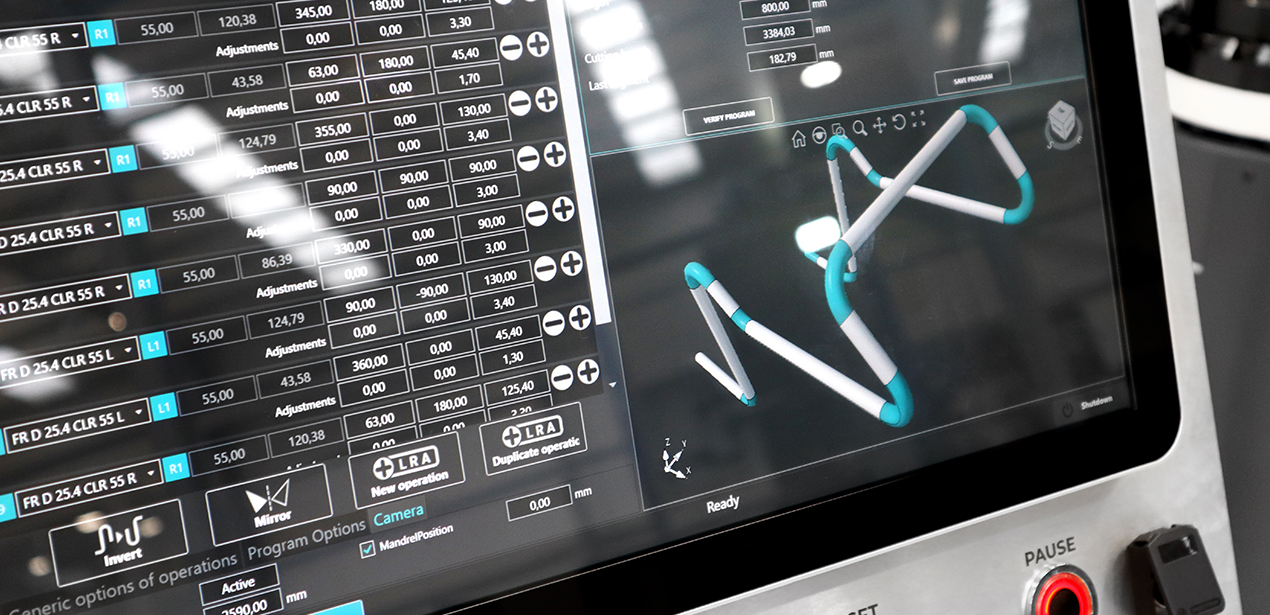
Instead of working only with numerical values or isolated coordinates, a 3D graphical interface makes it possible to visualize the part and more easily understand the result of each operation.
With VLB 3D Software, programming can be prepared graphically, allowing the user to visualize the part and the bending process before it is carried out.
This approach is particularly useful for complex parts, where an exclusively numerical representation makes it more difficult to anticipate how the tube will behave throughout the entire cycle.
Can CAD models be used in programming?
Using CAD data can significantly simplify the transition from design to production.
When the geometry already exists digitally, the ability to import that information means the entire part does not need to be manually defined again.
This creates a more direct workflow between engineering and production:
CAD design → programming → simulation → validation → production
In addition to reducing duplicated work, this approach helps decrease manual data entry errors.
In a production environment with many part numbers or complex geometries, this integration becomes especially relevant.
How does simulation help prevent collisions?
One of the most important applications of simulation software is the early detection of potential collisions.
While a complex part is being bent, the already formed tube can come close to different machine or tooling components.
A collision may require you to:
- Change the bend sequence
- Reposition the part
- Review the programming
- Modify the tooling
- Reassess the feasibility of the geometry
Identifying this problem only during production means occupying machine time and potentially wasting material.
By simulating the process in advance, these situations can be studied before the part is physically produced.
Can the software help compensate for springback?
When a tube is bent, the material tends to partially return to its original shape after the bending force is removed.
This phenomenon is known as elastic recovery, or springback.
Its behavior depends on several factors, including:
- Material type
- Tube diameter
- Wall thickness
- Bend radius
- Part geometry
Compensating for this behavior is important so that the angle produced matches the defined geometry.
VLB 3D Software includes correction features that help optimize this process and reduce the need for successive adjustments during production.
This capability is especially relevant when there are demanding dimensional tolerances or repetitive production.
Is it possible to determine cycle time before production?
Cycle time is one of the main indicators used when planning series production.
Knowing in advance how long a part may take helps estimate:
- Production capacity
- Number of parts per shift
- Machine utilization
- Order planning
- Production costs
Simulation makes it possible to evaluate the process before the part actually enters production and analyze potential optimization opportunities.
A change in the sequence of movements, for example, may reduce nonproductive time over thousands of cycles.
Therefore, software should not be viewed solely as a programming tool. It can also play an important role in improving production efficiency.
How can software reduce setup time?
Whenever a new part number enters production, the machine must be prepared.
Some of this work can be transferred to the digital stage.
If the geometry, sequence, and key parameters can be prepared and validated in advance, this reduces the number of decisions and corrections required while the machine is stopped.
This is particularly important in companies that work with:
- Many part numbers
- Small and medium production runs
- Frequent product changes
- Geometrically complex parts
In these environments, saving a few minutes during each setup can represent a significant cumulative gain over the course of a year.
What is the relationship between 3D software and waste reduction?
Each part used to test a program represents raw material, machine time, and labor.
The more tests required to obtain a conforming part, the higher the preparation cost.
Virtual simulation does not eliminate the need for physical production validation, but it makes it possible to reach that stage with a much better-prepared process.
By anticipating problems related to geometry, sequence, or collisions, the number of attempts required can be reduced.
This is also one of the reasons software, CNC, and engineering are increasingly inseparable in modern industrial production.
Does software replace the operator’s knowledge?
No.
Software is a tool that supports decision-making and programming. Knowledge of materials, tooling, geometries, and tube behavior remains essential.
The difference lies in the quantity and quality of information available before production begins.
An experienced operator, supported by a 3D simulation tool, can analyze the process in greater detail and make more informed decisions.
Technology does not replace experience. It helps turn it into a more predictable and repeatable process.
When is it especially important to use 3D simulation?
The use of software becomes particularly relevant when there are:
- Parts with multiple bends
- Three-dimensional geometries
- Demanding bend radii
- Tight tolerances
- High production volumes
- High-cost material
- Frequent changes between part numbers
- A need to reduce setup times
The higher the cost of discovering an error during production, the greater the value of identifying it in advance.
Software and machine should work as a single system
The evolution of tube bending machines is not limited to mechanics.
CNC control, electric drives, automation, and software are now part of the same production system.
A CNC tube bender can offer high levels of accuracy and repeatability, but efficient production preparation is equally important to take advantage of that capability.
That is why process digitalization begins before the machine’s physical movement.
VLB 3D: preparing the bend before it reaches the machine
VLB 3D Software was developed to make programming VLB machines more visual, predictable, and efficient.
The ability to work with part geometry, simulate the process, and anticipate potential problems makes it possible to better prepare production before actually occupying the machine.
For companies that work with complex parts, multiple part numbers, or high productivity requirements, this integration between software and equipment represents an important advancement over processes based predominantly on trial and correction on the machine itself.
Conclusion
3D software for tube bending makes it possible to transfer an important part of production preparation from the physical environment to the digital environment.
Programming, visualizing, and simulating a part in advance helps detect potential collisions, optimize sequences, compensate for material behavior, and analyze the process before the first production run.
The result is a more predictable process, with less need for testing, better machine utilization, and a greater ability to consistently produce complex parts.
If you would like to understand how programming and simulation can be integrated into your process, learn about VLB 3D Software or contact VLB’s technical team to analyze the requirements of your application.
Recommended Reading
Digitalization is just one of the areas transforming the bending industry. In the article The Latest Advances in the Tube Bending Industry, you can explore the evolution of CNC technology, automation, and digital integration in production in greater depth.
If the goal is to improve the quality of the parts produced, also read How to Prevent Deformation During Tube Bending, where we explain the main factors that influence problems such as ovalization, wrinkling, and flattening.
To learn about the equipment where these technologies can be applied, also explore VLB’s range of tube bending machines.
Written by: Patrícia Gonçalves